


Heroes of Might and Magic II
The Succession Wars
Eternal Cuddly Game #5

Type of game
The first proven masterpiece of videog-game-based therapy, through calmness and laughter. Guaranteed healing! Unfortunately, it is unlikely to be covered by health insurance.
Release date on our machines
October 1996, a period saturated with incredible video games in my head and on my computer, and yet...
Developer
New World Computing, Inc., the first ones I would resurrect if I were an expert in necromancy.
Publisher
The 3DO Company, the second ones I would resurrect, but before they would release their console. And... they wouldn't release it, mind you.
Heroes of Might and Magic II : available on GOG.com, and on the Ubisoft Store, both as the Gold Edition, packed with the expansion. Well, let's go buy it on GOG, right ?
My first encounter with this title isn’t exactly one of my most romantic stories. One day, as I was walking past my stepfather’s office, I spotted a box of burned CDs—almost brand-new, yet already half-broken—with a measly black-and-white scrap of paper tucked behind the lid to serve as a sleeve. I grabbed it, wondering what kind of weird program that narcissistic pervert on duty had gotten his hands on this time, just to brag to his friends and family about how good he was at hacking. Then I realized it looked like a game—though probably really ugly and totally fake—and I tried it anyway, but really just because I had nothing else to do at the time. And then, OH MY GOD! Ultra-mega awesome! And super pretty, too! Dude, stepdad, you could’ve at least warned me that you’d hacked something this amazing! You were never going to tell me, were you? You were going to keep it to yourself and toss it in the trash three days later. I’ve never seen you spend even a second controlling a hero or building a single structure in the world of Enroth, you damn a… okay, I’ll calm down.
Not great artefact

Of course, I never asked him directly to solve this age-old mystery. Why did he get his hands on so many video games—no one knew how—why didn’t he ever play them, and why did he keep them a secret while leaving them lying around in plain sight in the apartment? As soon as I clicked “New Game,” I didn’t care about knowing the answers anymore—I loved Heroes of Might and Magic II so much.
Medieval Fairy Tale

Although I’d already dabbled a bit in real-time strategy games like Command & Conquer and turn-based RPGs like Warriors of the Eternal Sun, I’d never seen a game that combined the two—while adding a whole bunch of other elements. Not only do you build your own cities (the knight’s, the barbarian’s, the witch’s… for a total of six), but you also lead your armies into battle (six different creatures per city, ranging from moldy skeletons to majestic phoenixes, including brute minotaurs and gleaming paladins, plus a few others that aren’t aligned with either side), and you nurture your heroes by teaching them skills and spells, all while equipping them with magical items. The playing field serves as a massive interactive board that can feature seven types of terrain, including grass, snow, and desert—and even eight if you count water. Let’s say eight, then, since you can also travel across water by boarding a boat.
There, you’ll meet millers, witches, mysterious hermits, and all sorts of creatures—some friendly, some hostile. In certain levels and in the story-driven campaigns, a real narrative unfolds as time passes and you explore new locations. By the way, did I mention the resources? Golden gold, brown wood, yellow sulfur, gray iron, pink crystals, silvery mercury, and multicolored gems! Say that line just like in the old Lucky Charms commercial—you’ll see how satisfying it is. Doesn’t anyone want to give it a try? Uh, well, I was saying that the gameplay gave me the most incredibly cool dizzy spell of my life. I really felt like I was playing three games at once. It didn’t have the most finely tuned balance, if you look at details like this: a single genie can cut the number of enemy creatures it attacks in half (even if that means vaporizing two thousand titans).

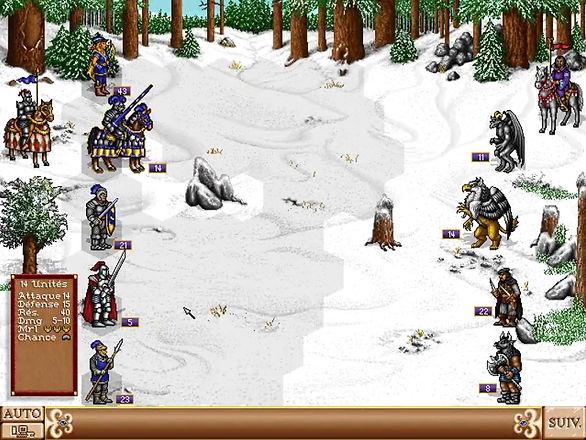
Or the ghosts that start the battle at twenty and end it at nine hundred twelve, because each of their victims joins their ranks in real time. But the exploration/construction/battle loop unfolds in the most beautiful way. Even though I loved the phases of building and fortifying our strongholds (on a fixed screen that gets increasingly detailed), as well as the epic clashes on the battlefield (a grid made up of hexagons—a “hex-grid,” in other words—in a very weird but very stylish isometric view), I far preferred the adventure sessions (in an isometric view that’s much less bizarre and even more stylish), which are every bit as good as those in Grandia, even if they’re completely different. I discovered thousands of wonderful scenes there, where each type of terrain takes us on a journey and captivates us in its own way.
For example, when we let our hero rest near an enchanted fountain that delights us with its mesmerizing flow. A little further on, the bleating of a goat drifts toward us from a welcoming farm, while from a crystal mine, we can hear the workers chiseling away at the rock with their old, rusty pickaxes. Heroes 2, as I called it—and no doubt everyone else did too—taught me the benefits that impeccable pixel art could have on me, especially when paired with equally melodious sound design. During moments like these, a kind of divine grace envelops our soul in the coziest cotton in the world. Nothing can happen to us anymore; our problems vanish (especially the problems of an eleven-year-old kid—problems that are both trivial and of the utmost importance).


What did I say about the battles a little earlier? Epic clashes? Hahahahah, my bad. Yeah, it’s a different vibe compared to the serene landscapes you ride through on horseback—no doubt about that. But, um, while I’ve felt a certain anxiety during tough battles, or a sense of omnipotence when I crushed my opponents, there’s nothing epic about it at all. In fact, the battles had me laughing my head off. The creatures’ jerky movements, their indignant groans when they took a hit, the flurries of blows and counterattacks when you set the animations to “very fast” in the options… it was just as hilarious as a fairy hovering around a circle of magic mushrooms in an enchanted forest could ever be soothing. And to think that Heroes 1 took the genre even further…
When I say we were laughing, my friends and I were literally rolling on the floor, holding our stomachs. And by “friends,” I don’t mean two or three random people who’ve long since faded from my memory, but mainly Randall Geyser, who immediately jumped on the hype train. For once, I was the one showing him a computer game—not the other way around. The dragons with their cute little snouts, the goblins with their cries that were as pathetic as they were funny, the iron-and-steel golems that look like Jean Reno—not to mention the elves (who don’t look anything like Orlando Bloom or Evangeline Lilly), the hobbits, and the orcs who burp when you hit them. I’m not sure the developers intended for us to come away from every skirmish with cramps in our abs.


Although, when you see the faces of some of these heroes, you end up wondering if the whole point of Heroes of Might and Magic II isn’t just to make us laugh ourselves to death. A good half of these knights, mages, witches, and barbarians were portrayed with teeth that are far too visible for us not to notice a grotesque pattern. And between those who smile like idiots, pull the most ridiculous faces, or sport an unbreakable deadpan expression, it’s impossible to get bored. How many times have we recruited this or that character into our ranks, just for the pleasure of admiring their ridiculous looks at will? Way too often—and we ended up losing the game as a result. Still, you can sense an effort to maintain a certain consistency tied to various mythologies, which define the entire theme of their respective cities. Big thumbs up for immersion.
We want to keep the creatures belonging to the same city category together. First, it boosts their morale more than if we mixed them with individuals from other backgrounds. Second, it looks better visually, with the same uniform background enhancing each unit’s miniature. There! It’s clean, tidy—everyone in their place! This gives new meaning to the word “communitarianism.” I didn’t say this was good news, but it does have the merit of being a change from the usual crooked politicians. On the other hand, Heroes 2 turning me into the interior minister of a crypto-fascist government—I didn’t see that coming at all. Did I almost go off the rails because I was forced to keep the pigs together? Not even Master of Orion II would have made me that sectarian.

Enchantment by sounds
The music follows much the same pattern as the rest: some pieces transport us with their beauty and melancholy, while others produce the exact opposite effect. What do you call the opposite of a lovely melancholy? Jerky snickers—exactly! And interestingly, this doesn’t happen during the fights—whose somewhat martial rhythms tone down the general chaotic fun a bit—but rather in the cities. Putting yourself in the shoes of a kid raised on Eurodance, alternative rock, and mainstream rap helps you understand the shock you’re in for. So, clicking on a haunted castle to go inside and being greeted by an opera singer at the height of his career—that’s just weird! The guy’s belting it out in German, too (no double entendres intended here—it’s just that the harshness of the language doesn’t help). No one mentally prepares kids for that kind of encounter. Okay, I’m exaggerating a bit—especially since back then, my computer played the tracks in MIDI format, so without vocals. Needless to say, the songs got pretty mangled by the trusty Soundblaster. Which one? I don’t remember, but it was numbered with a digit that was a power of two. I discovered the soaring vocals of the sopranos and baritones when I popped the disc into my stereo one day—I’d decided to do that with all my PC games, just to see what would happen. Surprise guaranteed! Just as much as WipEout, but not in the same genre. Then I noticed that by poking around in the menu, I could enable the Hi-Fi + Opera sound, so I did. It changed which tracks were assigned to certain cities, removed one track from the terrain music, and completely replaced the main menu soundtrack—but that didn’t stop me from enjoying it… and having a good laugh. These days I prefer to listen to the MIDI versions again, with a few exceptions—probably because I also like to suffer for no reason. That said, while I love every track on this soundtrack, nothing comes close to the themes accompanying the adventure map—especially those for the grass, dirt, and swamp terrains—which still bring me to tears of nostalgia today. The trio of Paul Romero, Robert King, and Steve Baca has since become one of my all-time favorite composers. Their works reach levels of perfection I could never have imagined, even in my wildest music-loving fantasies. But since I’m starting to get a little carried away, overwhelmed with emotion just talking about it, I’d rather listen to something fun. With vocals, please.
But still, listen to this—it’s a truly beautiful track, a thousand times more beautiful than even the best of your sealed retro games, rated 95+ and displayed on a diamond-encrusted shelf, illuminated by divine spotlights.
False notes and contraband
One last detail is what really hooked us on this game: the hot-seat mode, which let us play multiplayer games on the same computer. It brought back that sense of camaraderie inherent to consoles—something we’d lost when PCs started flooding into homes. Without exaggerating, we had some pretty incredible times, even if we didn’t often manage to finish the epic campaigns we’d started. It took too long, and that meant we’d have to meet up over several days to pick up where we’d left off. Because, of course, as true addicts of the concept, we played almost exclusively on the largest maps. For the first few hours, we’d dive in with unwavering seriousness. Then, after a while, the madness would go to our heads, and there was nothing we could do about it. Such was the hidden power of Heroes 2. We’d start acting like complete fools—rolling around on the floor or spouting nonsense in the voices of total idiots. But the game went crazy, too! The music would suddenly sound completely off-key—without warning—both on the adventure map and in the towns. And I mean really out of whack! The melody would go haywire and play nothing but wrong notes. Except that, unlike us, it would go back to normal after half an hour. I never figured out why it fixed itself, but the excuse to have even more fun was obvious. Anyway, there was the ultimate tool to make us happy: a level editor! We could more or less create whatever worlds we wanted, with a little thought, quite a bit of time spent designing them, and a whole lot more time testing them. Well, we often skipped the testing phase—and sometimes the design phase too—which led to absurdities like starting a scenario with ten heroes armed with six stacks of 9,999 black dragons, dropped into a shoddy and not even functional environment.

Once, I’d dug insurmountable holes between the enemies and me; I could never lose—or win—way to go, buddy. Randall and I would swap our experiments, a floppy disk containing the map files stashed in our backpacks. We’d pass it around discreetly during recess at middle school, as if it held the world’s most secret information! At the same time, we weren’t really supposed to be walking around with floppy disks—whether they contained snippets of digital brilliance from Heroes 2 or instructions on how to blow up the school. But we did it anyway, and we thought of ourselves as high-flying dealers. That was the extent of our civil disobedience. Maybe we should have taken it a step further than that.
Follow Heroes of Might and Magic II publications on the social media!
